Across Hera Bay and Atauro Island, the IKI Seagrass Ecosystem Services Project combined seagrass mapping, fish surveys, household surveys, local ecological knowledge and community engagement to demonstrate how seagrass supports fisheries, food security and coastal livelihoods.
The results reveal two contrasting seascapes. In development-adjacent Hera Bay, extensive seagrass meadows support local fisheries but face pressures from sedimentation, pollution, infrastructure, anchoring and fishing. On Atauro Island, community-based management through Tara Bandu and Locally Managed Marine Areas (LMMAs) provides a contrasting model for locally governed marine resources.
Research and Science
Up to 248 hectares of seagrass mapped in Hera Bay
The project delivered the first detailed spatial assessment of seagrass extent and condition in Hera Bay.
Drop-camera surveys and intertidal quadrats generated 275 targeted waypoints, supplemented by 83 citizen science observations from Seagrass Spotter. Seagrass was recorded at 260 of the resulting 358 mapping points, with average cover of approximately 37%.
The surveys recorded:
- 10 seagrass species
- 131 hectares of high-confidence seagrass habitat mapped
- up to 248 hectares when areas with a ≥60% probability of seagrass presence were included.
Fish abundance and diversity were substantially higher at the Atauro survey sites
Baited Remote Underwater Video (BRUV) surveys provided new evidence on fish communities associated with seagrass in Hera Bay and Atauro Island.
Within Hera Bay, fish abundance and species richness varied between fishing zones, the highest values recorded at Beraka and some of the lowest at development-adjacent locations:
- Beraka: average fish abundance = 4.8, species richness = 3
- Turismo (development adjacent): average fish abundance = 1.7, species richness = 1.7
The contrast between Hera Bay’s sites and Atauro Island’s Beloi and Bikeli sites was substantial:
- Beloi: average fish abundance = 113, species richness = 24.9
- Bikeli: average fish abundance = 120.6, species richness = 27

Policy and Management
Community-led marine management is being connected with formal governance
On Atauro Island, communities established Locally Managed Marine Areas (LMMAs) under Tara Bandu customary law, agreeing on restrictions on fishing gears and seasons, creating no-take areas and enforcing community-agreed sanctions.
Working with Blue Ventures, a formal process for establishing Tara Bandu LMMAs was submitted to the Ministry of Agriculture, Livestock, Fisheries and Forestry, with the aim of securing local management rights and facilitating replication elsewhere.
The project’s evidence strengthens the case for explicitly incorporating seagrass into these community management systems. Fish surveys and household evidence demonstrate the importance of seagrass to fisheries and local priorities, providing a foundation for expanding management approaches that have traditionally focused more strongly on coral reefs.

Communications and Awareness Raising
Local capacity was built to monitor and understand seagrass
The Timor-Leste assessment was designed around community participation and co-production rather than data collection by outside researchers alone.
In Hera Bay, local enumerators and project staff were trained in survey methods, digital data collection and interviewing and went on to lead household survey implementation. Training also covered Seagrass Spotter, Baited Remote Underwater Video (BRUV) deployment and basic ecological survey methods, building local skills that can support repeat monitoring beyond the project.
Project findings were then taken back to coastal communities through meetings and discussions. Maps and other visual materials helped people interpret seagrass distribution, fisheries patterns and potential management options.
Seagrass gained greater public visibility in Hera
Community engagement extended beyond the research participants. World Seagrass Day events provided a platform for publicly sharing seagrass information and project findings, while illustrated information boards installed in Hera Bay created a lasting local resource for awareness and discussion.

Seagrass monitoring at Atauro Island in Timor-Leste.
© Blue Ventures
Communities and Livelihoods
147 households documented the importance of seagrass to food security and livelihoods
Household surveys covered 147 households in two coastal areas of Hera Bay – approximately one third of households in the immediate area – demonstrating the importance of marine resources to everyday livelihoods.
Among surveyed households:
- 64% reported line fishing
- 29.1% reported gleaning
- 20.5% reported net fishing
- 28% identified seagrass as their most important fishing habitat, second only to reef crest
- 46.7% reported decline seagrass health
- 47.6% reported declining fish catches over the previous five years.
The surveys also highlighted different patterns of resource use within households. Men were more involved in fishing, while women and youths’ marine-resource participation was more strongly associated with gleaning.
Community enterprises linked conservation to local income
On Atauro Island and subsequently in Beto Tasi, community homestay models supported by Blue Ventures created alternative income linked to ecotourism, providing a way to diversify livelihoods while strengthening community engagement in marine stewardship.
In Beto Tasi, at least 10% of homestay profits are allocated to a community fund for LMMA management under Tara Bandu laws. The wider community-fund model supports local development, ecotourism and marine conservation and management activities.
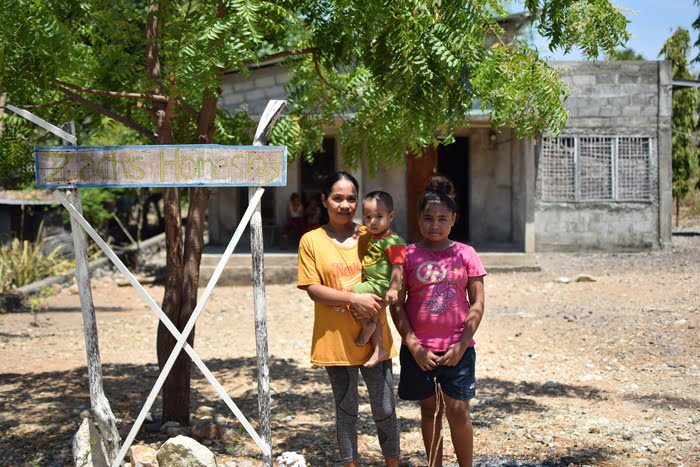
Business model: Community homestays on Atauro Island
On Atauro Island, the IKI project established a community homestay model that allows local households to earn directly from visitors while showcasing the island’s coastal environment and culture. The approach builds on earlier community tourism work on the island. In one previous programme, homestays recorded 1,593 tourist nights at US$15 per night, generating US$24,000 for the Homestay Association and roughly doubling the annual income of participating households. Darwin Initiative: Atauro Island
Connecting tourism with seagrass conservation
The model sits alongside IKI’s work to understand and protect Atauro’s marine ecosystems. The project assessed seagrass at Atauro as a reference site and documented the links between seagrass, fisheries and local livelihoods. In neighbouring Hera, the project helped support the establishment of a 247-hectare locally managed marine area under community leadership and Tara Bandu customary law. Timor-Leste Seagrass Ecosystem Services Report IKI: Traditional knowledge and conservation

Fishers, gleaners, local leaders and BV staff at the Hera LMMA workshop (June 2024).