In Malaysia, the IKI Seagrass Ecosystem Services Project concentrated on generating ecological and blue carbon baselines for contrasting seagrass systems in Johor.
The work compared the accessible intertidal meadow at Pulau Setindan with the subtidal seagrass meadows of Pulau Sibu Tengah and Pulau Tinggi, within the Johor Marine Park and an Important Marine Mammal Area for dugongs.
Research and Science
Comparing intertidal and subtidal seagrass systems
The project combined seagrass habitat assessments with Baited Remote Underwater Video surveys to compare fish communities across the Johor sites.
The results showed clear differences between the intertidal meadow at Pulau Setindan and the submerged Sibu–Tinggi meadows, reinforcing the need for site-specific management rather than treating Malaysian seagrass as a uniform habitat.
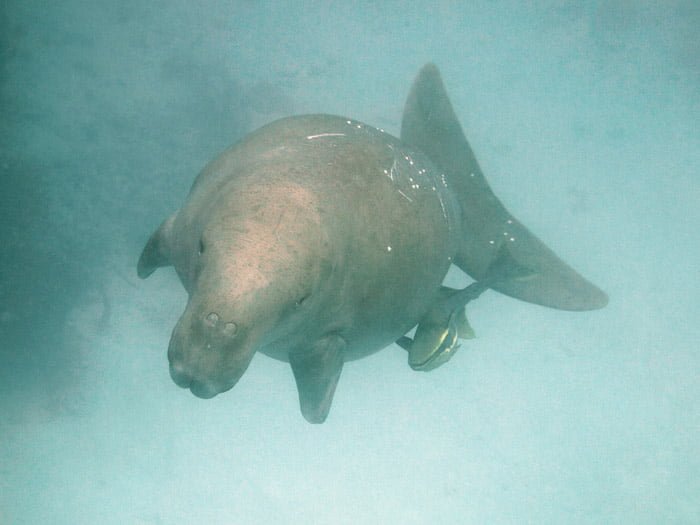
Fish recorded included fisheries-relevant groups such as emperors, snappers and whiptails, while surveys in the Sibu–Tinggi archipelago also confirmed dugong feeding trails within the seagrass meadows.
These observations provide direct evidence that the subtidal meadows function as dugong feeding habitat as well as supporting fish communities.
Blue carbon measurements established a site-specific Malaysian baseline
Sediment sampling quantified carbon storage across Malaysian seagrass sites and demonstrated strong spatial variability.
The Malaysia dataset produced a particularly strong site-specific relationship for blue carbon estimation, with the Final Report assessing the country’s MRV readiness as Tier 1 with strong site-specific relationships (R² = 0.72).
Stable-isotope analysis also showed that carbon stored within seagrass sediments does not necessarily originate only from the seagrass itself. At some sites, a substantial contribution came from adjacent mangrove ecosystems, providing quantitative support for managing these habitats as connected blue carbon seascapes.
The project’s Malaysia blue carbon dataset was published as Blue Carbon Opportunities: seagrass carbon storage and accumulation rates at Johor and Penang, Malaysia, creating a reusable technical baseline beyond the project itself.

Policy and Management
Evidence from Johor exposes a clear protection gap
The project’s sites provide a direct governance comparison.
The subtidal meadows of the Sibu–Tinggi archipelago lie within a Marine Park and an Important Marine Mammal Area, while the intertidal meadow at Pulau Setindan remains more exposed to development pressures.
This comparison matters because Malaysia’s protected-area frameworks can include seagrass without necessarily establishing explicit seagrass indicators or management objectives.
At national level, Malaysia’s NDC 3.0, submitted in October 2025, recognizes coastal protection but does not explicitly include seagrass.
Communications and Awareness Raising
Two films made the dugong–seagrass–community connection visible
Malaysia produced two community films in 2023:
Cara Pulau Kita (Our Island, Our Way) focused on island-community dependence on seagrass.
Dugong Tears & Sea Stories of Pulau Sibu focused on dugong conservation and the importance of seagrass as feeding habitat.
These outputs complemented the technical data with a locally grounded account of why submerged seagrass matters to island communities.
Maps, BRUV results and blue carbon findings were also shared through stakeholder demonstrations, briefings and engagement with local site managers, translating technical datasets into material that could be used in discussions about Johor’s marine environment.

Communities and Livelihoods
Field engagement documented different forms of dependence on seagrass
Community evidence comes primarily from field engagement with fishers, gleaners, island communities and site managers.
At Pulau Setindan, women and children were documented gleaning the intertidal meadow for bivalves for household consumption and marine worms used as fishing bait.
In the Sibu–Tinggi archipelago, the relationship with seagrass is different. The meadows are submerged, but fishers associate them with fisheries and with the dugongs that use the islands’ waters.
The BRUV surveys and confirmation of dugong feeding trails provided ecological evidence for these locally observed relationships.

Business model: Pulau Sibu products and blue carbon
Before the IKI project, MareCet worked with women on Pulau Sibu, Johor to develop a small livelihood enterprise linked to dugong conservation. With support from the GEF Dugong and Seagrass Conservation Project, women received sewing and product-development training and produced dugong-themed pouches, tote bags and plush toys. A second training phase introduced costing and additional products including headbands, passport holders and toiletry bags. MareCet also planned to support marketing and business development, with sales proceeds supporting the women involved and dugong conservation. The aim was to develop a sustainable cottage industry based around Pulau Sibu’s dugong identity. MareCet: Pulau Sibu Women Livelihood Development Project
Adding blue-carbon evidence
The IKI project subsequently expanded work in Malaysia through research on seagrass ecosystem services in Johor and Penang. In the Sibu-Tinggi area, studies assessed seagrass biodiversity, fisheries-related ecosystem services and carbon stored in seagrass sediments. At Pulau Setindan and Pulau Sibu Tengah, measured carbon stocks ranged from 9–36 Mg Corg ha⁻¹. This work provides a baseline for understanding the wider economic value of protecting these meadows, alongside their importance as dugong habitat and for marine biodiversity. IKI project: Seagrass Ecosystems

custom-designed dugong plushes via MareCet